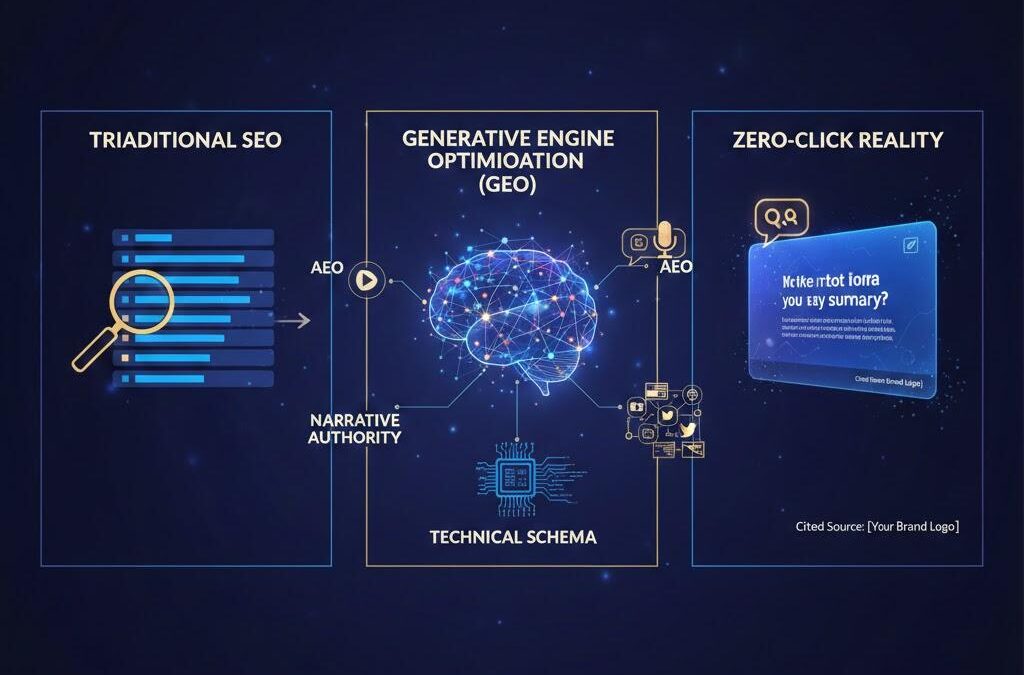
In 2026, the definition of “traffic” has fundamentally shifted. We are no longer living in a world where a blue link and a high click-through rate are the only markers of success. With the rise of sophisticated AI Overviews (SGE) and Generative Engine Optimization (GEO), your website’s primary job is no longer just to get the click—it’s to become the source.
If an AI provides a comprehensive answer to a user’s query using your data, and the user never visits your site, have you lost? Not necessarily. In this new landscape, brand citation is the new currency. Here is how to ensure your website remains the authoritative voice that AI models trust and quote.
The Shift from Keywords to “Information Gain”
Search engines have moved past simple keyword matching. They are now looking for “Information Gain”—the inclusion of new, original facts or perspectives that aren’t already present in the top 10 search results. To optimize for AI overviews, you must stop summarizing what others have said and start publishing proprietary insights, first-hand case studies, and unique data sets.
Structuring for Machine Readability and Human Trust
While we write for humans, we must format for machines. AI models prefer clear, conversational structures. Use direct answers to complex questions early in your articles. This “inverted pyramid” style of writing ensures that when an AI scans your page, it finds the “nugget” of wisdom immediately, increasing the likelihood of your brand being cited in the AI-generated summary.
Becoming a “Citable” Authority
To win in the age of AI, your content needs to feel lived-in. Use personal anecdotes, specific London-market observations, and “earned secret” insights that an LLM couldn’t simply hallucinate. When your content is undeniably human and factually dense, you stop chasing the algorithm and start leading the conversation.
The “Like” button is becoming a ghost of social media past. In the sophisticated landscape of Social Media Management today, a double-tap is no longer a sign of success—it’s a signal of passive consumption.
As of February 2026, Instagram has officially unified its primary performance metric to “Views” across all formats. This shift confirms what we at Wowspot have known for months: the algorithm no longer cares if people like your content; it cares if they value it. For London’s elite brands, staying relevant requires a swift pivot in your content strategy.
1. Shares per Reach: The DM Is the New Storefront
In 2026, the most powerful signal you can send to the Instagram algorithm 2026 is the “Send.” When a user shares your post via Direct Message (DM), they are effectively vouching for your brand in a private, high-trust environment.
Current data shows that “Shares per Reach” is now weighted three times more heavily than a standard like. If your content isn’t “send-able”—meaning it isn’t providing a unique insight, a relatable laugh, or a “must-see” moment—it will likely disappear from the feed within hours.
2. Average Watch Time: Retention Equals Reach
Retention is the new currency. With the introduction of the “Your Algorithm” feature for Reels, users now have direct control over their topical interests. However, the AI still prioritises Short-Form Video & Visual Production that keeps users on the platform.
A Reel that achieves over 110% average watch time (meaning users are re-watching) receives up to 300% more distribution. For a London Digital Agency, this means the first three seconds of your video—the hook—are the most expensive real estate in your marketing budget.
3. Social Search & SEO Signals
Instagram is no longer just a social network; it’s a search engine. Younger demographics in London are now using social platforms over Google for brand discovery. Your Social Media Management must now include “Social SEO.”
The algorithm now “listens” to your audio and scans your captions for keyword relevancy. If your post doesn’t contain the specific keywords your target audience is searching for, you are effectively invisible, regardless of how many followers you have.
Key Takeaway
To thrive in 2026, London brands must stop measuring popularity and start measuring intent. Focus on content that sparks a conversation (DMs), demands attention (Watch Time), and answers a question (Social SEO).
The Death of Vanity Metrics: Why Your “Likes” No Longer Matter
In the fast-paced London digital landscape, staying ahead of algorithm shifts isn’t just a benefit—it is a survival tactic. As of February 2026, LinkedIn has fully rolled out its most significant update to date: the 360Brew algorithm. This 150-billion-parameter AI model has fundamentally changed how organic reach is distributed in the UK and beyond.
The era of “engagement baiting” is over. LinkedIn now utilizes a sophisticated Depth Score to determine which content deserves the spotlight. If your current Social Media Management strategy still focuses on chasing likes and short-form “bro-etry,” you are likely seeing a sharp decline in reach.
What is the 360Brew Depth Score?
Specifically, the Depth Score is a multi-layered metric that evaluates the quality of professional interaction. Unlike the legacy system, which prioritized the sheer volume of reactions, 360Brew “reads” content like a human editor. It rewards Social Media Strategy that prioritizes three core signals:
Dwell Time: The algorithm tracks how many seconds a user spends reading your post. Clicks on “See More” are now weighted more heavily than a simple “Like.”
Meaningful Dialogue: A “Great post!” comment is now classified as “engagement noise.” Conversely, multi-sentence replies and threaded discussions act as a massive reach multiplier.
Saves and Private Shares: If a user saves your post or sends it via DM, the algorithm views it as high-value, “referencable” expertise.
Key Takeaway: Stop broadcasting and start narrowcasting. One deep, insightful post per week will outperform five shallow daily updates in the 2026 landscape.
Augmenting Authority with AI Content Creation
Consequently, many London firms are struggling to maintain the quality required for high Depth Scores. This is where AI Content Creation becomes your most powerful ally. At Wowspot, we use AI not to replace the human voice, but to amplify Narrative Intelligence.
By using AI to synthesize industry data and structure complex frameworks, we ensure your content provides the “Depth” the algorithm craves. This hybrid approach allows for consistent Content Creation that remains authentic, legally compliant, and strategically aligned with your brand’s core pillars.
Generative Engine Optimisation: Mastering the New Era of AI Search
The traditional SEO playbook is undergoing its most radical transformation. As of early 2026, Generative Engine Optimisation has shifted the digital battlefield from standard search results to AI-driven summaries. For London’s premier brands, the goal is no longer simply to rank; it is to be the authoritative source that AI models cite as the absolute truth.
Why Generative Engine Optimisation Matters for London Brands
Generative Engine Optimisation (GEO) is the strategic process of making your brand’s content more likely to be included in AI responses. Unlike old-school SEO, this new frontier prioritises conceptual authority.
In the London market, where “Zero-Click” searches now account for over 60% of mobile traffic, mastering AI Search Optimisation is the only way to stay visible. If you are not appearing in the generative summary, you essentially do not exist to the modern consumer.
The Strategy Behind Answer Engine Optimisation (AEO)
A core pillar of this new search frontier is AEO. This involves structuring content to answer complex queries directly. By using a “Claim-Evidence-Data” format, you make it easier for AI models to extract your insights.
Furthermore, Generative Search Optimisation relies on semantic relevance. You must ensure your site’s technical schema is perfect so that search engines can verify your London-based expertise instantly. By providing structured data, you allow AI agents to parse your “Brand Narrative” without friction, which is the secret sauce for appearing in high-intent search summaries.
Adapting Your Content for the UK Market
Success in the current landscape requires more than just technical tweaks; it requires a shift in editorial tone. UK consumers are increasingly looking for transparent, expert-led advice that cuts through the noise. When creating content for your London audience, ensure you are referencing local case studies, UK-specific regulations (such as GDPR or CMA guidelines), and British industry standards.
AI engines prioritize “Information Gain”—the concept of adding new, unique value to the existing conversation. If your blog post simply repeats what is already on Wikipedia, the generative engines will ignore you. Instead, lean into Wowspot’s data-first approach: use original insights from your paid social campaigns and visual production metrics to provide a perspective that an AI cannot find anywhere else.
Key Takeaway: To win in 2026, brands must pivot from “keyword matching” to “knowledge providing.” If your content doesn’t offer a unique, data-backed perspective that an AI can verify, it won’t be seen. Generative Engine Optimisation is about building a digital narrative so strong that an AI engine cannot ignore it.
For more insights on our recent projects, view our [Social Media Management] services or contact our London team.
Generative Engine Optimisation (GEO) is no longer a buzzword; as of February 2026, it is the fundamental framework for digital visibility. For over two decades, digital marketing has been a game of “matching.” You find the keywords your audience types into a search bar, and you pepper them into your content. But as we move deeper into this year, the search bar is being replaced by the AI Agent.
Why Generative Engine Optimisation (GEO) is the New Standard
Whether it’s a London professional asking OpenAI’s “Operator” to “find the best social media agency for a luxury fashion launch” or a consumer using Google Gemini to “source ethically-produced homeware in Chelsea,” the interaction has changed. We are no longer optimising for clicks; we are optimising for citations through Generative Engine Optimisation (GEO).
Unlike traditional SEO, which focuses on ranking in the Top 10 blue links, Generative Engine Optimisation (GEO) focuses on inclusion and sentiment. If an AI shopping agent doesn’t mention your brand in its summary, you are effectively invisible—even if you rank #1 on traditional results.
The UK Legal Landscape: DUAA 2025 and Trust
Transparency is the new currency. With the Data (Use and Access) Act 2025 (DUAA) now in full effect across the UK, the way brands handle data is under a microscope.
AI agents favour brands that provide structured, verifiable data. This is why “Machine-Readable Wisdom” is a core pillar of our Strategy and AI Content services.
3 Pillars of Winning with Generative Engine Optimisation (GEO)
From Keywords to Entities: Stop thinking about “Social Media Agency London.” Start thinking about your brand as a “Verified Entity” with specific attributes.
Information Gain: AI engines synthesise. To be cited, your content must provide “Information Gain”—unique data or “Answer Capsules” (40-60 word direct responses) that an AI can easily lift.
Digital Consensus: AI agents cross-reference. Consistent Generative Engine Optimisation (GEO) ensures your LinkedIn, TikTok, and web presence tell the same story.
Key Takeaway: In 2026, visibility is no longer about being found; it’s about being understood. To stay competitive, London brands must pivot to Generative Engine Optimisation (GEO).