In the quiet, high-ceilinged offices of Marylebone and the glass towers of the City, a silent revolution has finalised its coup. The digital landscape has relegated the traditional search engine to a secondary tool. Today, optimising for AI assistants 2026 represents the primary objective for the London elite. Consequently, people no longer “Google it”; they simply ask their devices for a singular, trusted recommendation. If AI assistants do not recommend your brand immediately, you effectively do not exist in the modern ecosystem.
The Shift from Rankings to Recommendations
Traditional SEO focused heavily on volume and keyword density. However, optimising for AI assistants 2026 requires a sophisticated focus on trust and entity clarity. In the current market, AI engines do not merely look for “relevant content.” Instead, they seek out “verified authority.” These systems synthesise thousands of data points—from your website’s schema to your mentions in authoritative sources—to decide if you deserve a recommendation.
If the AI cannot parse your data instantly, the algorithm will skip your content entirely. Therefore, implementing advanced Schema Markup is no longer optional; it is the fundamental language of discovery. Your site must clearly define your “Entity.” Specifically, you must outline who you are, what you offer, and which problems your Management Plans solve for the London market.
2. Solving for ‘Natural Language’ Intent
AI assistants thrive on conversational context. As a result, your content strategy must shift away from broad terms like “London Real Estate.” Furthermore, you must answer the nuanced, high-intent questions of your audience. Consider the verbal prompts a busy executive gives their AI while stuck in traffic on the A4: “Find me a management plan that specialises in high-yield sustainable assets in East London.”
By focusing on optimising for AI assistants 2026, your whitepapers must provide these answers with surgical precision. This approach mirrors the high standards found at the Content Marketing Institute.
3. The Trust Signal: Third-Party Verification
Modern AI acts with inherent skepticism because it cross-references every claim you make. To secure a recommendation, you must build a “cluster of authority.” This process involves three key pillars:
Citations: Secure mentions in reputable UK publications to build digital footprints.
Sentiment: Manage your reviews so they reflect the “Quiet Luxury” London demands.
Consistency: Maintain identical, verified information across all London Digital Pulse updates.
The Conclusion for the 2026 Strategist
The era of the “Ten Blue Links” has officially ended. In contrast, we have entered the era of the Singular Answer. By pivoting your strategy to focus on AI legibility and conversational authority, you ensure that your brand remains the top choice. Ultimately, you must master the assistant or risk being forgotten by the market.
The digital landscape of the United Kingdom has reached a tipping point. As we analyze the latest market data, it is clear that 2026 social search habits have fundamentally transformed how London’s consumers—particularly Gen Z and Millennials—find products, services, and expertise. Recent reports from the Global Intelligence Scan reveal a staggering 86% shift in these patterns.
Why Discovery Patterns are Fragmenting the Market
In the current era, “searching” is no longer a singular action performed on a white screen. Understanding these modern 2026 discovery patterns requires looking at a fragmented, multi-platform journey. While Google remains a powerhouse for high-consequence decisions, the preference for TikTok and AI-driven “Answer Engines” has evolved into a sophisticated discovery layer.
TikTok: The primary hub for lifestyle and real-time intent.
Instagram: A visual directory where AI now indexes objects inside your Reels.
AI Assistants: Now accounting for 14% of direct search intent in London.
The “Discovery Loop” and Modern Intent
The traditional marketing funnel is dead. In its place is the Discovery Loop, a cycle driven by evolving user behaviors. A user might see a concept on a Pinterest “Identity Board,” search for the practical application on TikTok, and finally verify a brand’s “Topical Authority” on LinkedIn. To capture this audience, your Management Plans must be platform-native but search-optimised.
According to research by HubSpot, over half of consumers now start their journey on social media rather than a search engine. This means your brand needs to be “machine-readable” across all surfaces.
Strategic Pivot: Dominating the New Landscape
To align your brand with these shifting UK search trends, focus on three pillars:
Visual SEO: Use descriptive Alt-Text that AI nodes can index instantly.
AI-Ready Answers: Provide concise answers that “Answer Engines” can cite in their snapshots.
Human-Centric Branding: Focus on trust and verifiable credentials to stand out from AI-generated noise.
By diversifying your presence, you ensure that your business remains visible wherever the search bar appears next.
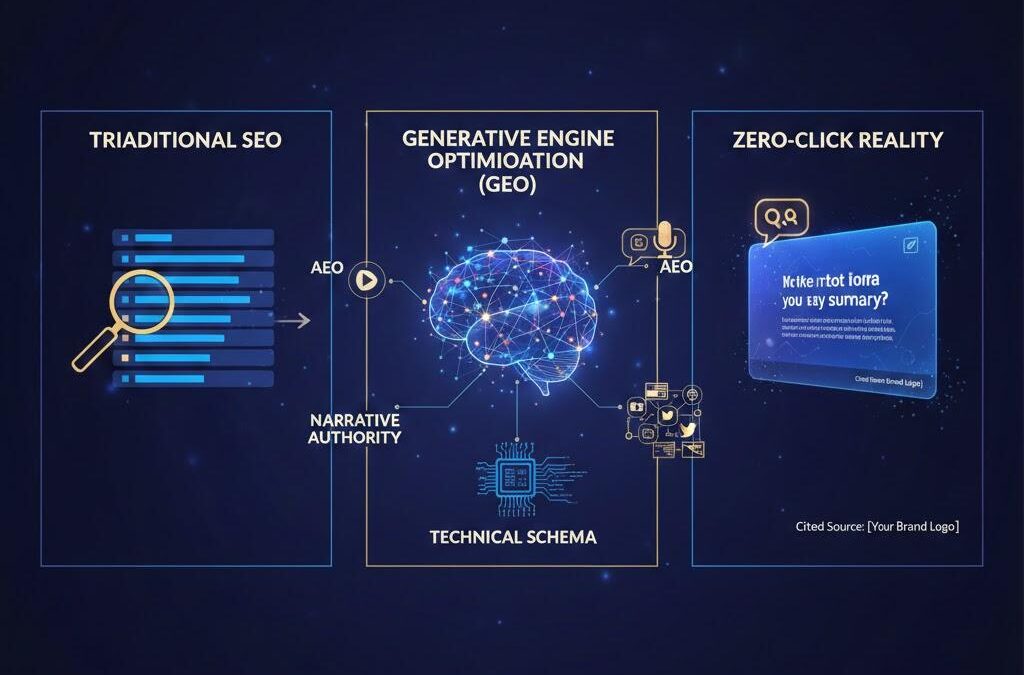
The transition from keyword-matching to Generative Engine Optimization (GEO) is complete. In 2026, visibility is no longer about “ranking” in a list of blue links; it is about being the primary source cited by the AI agents that mediate 85% of UK search traffic.
If your strategy still relies on keyword density over entity authority, you are effectively invisible to the modern intent engine. Here are the seven frameworks currently delivering the highest retention and citation rates for UK brands.
1. The Citation-Mining Architecture
Generative engines prioritise content that is easily cited. Instead of long-form narrative, structure your insights into “Citeable Units”—standalone sentences or paragraphs that contain a complete data point or expert opinion. This makes it frictionless for an AI to pull your brand into its summary.
2. Natural Language Chunking (NLC)
Stop writing for crawlers; write for conversational models. NLC involves structuring your post into clear Question-Answer-Evidence triplets:
The Question: What the user actually asks in plain English.
The Answer: A direct, 40-word summary that provides immediate value.
The Evidence: The verification data or case study that proves the answer.
3. Entity-Attribute Mapping
Google’s 2026 Knowledge Graph relies on how well you define “Entities.” When discussing a service or product, explicitly link it to its attributes (location, price-point, UK compliance status). This ensures the AI understands exactly what “category” you own.
4. Direct Answer Priming
Position your primary value proposition in the first 100 words. Generative engines frequently “skim” content. If the core insight is buried under a 300-word introduction, the engine will likely bypass your site for a competitor that gets to the point immediately.
5. The Verification Layer (UK OSA Compliance)
Following the UK Online Safety Act 2026, engines now penalise unverified claims. Every strategic claim in your blog must be hyperlinked to a primary source or a verified case study. Transparency is no longer a “nice to have”—it is a ranking signal.
6. Conversational Threading
Users now search via dialogue. Framework your content to answer the “follow-up” question. If your article is about “Business Rates in London,” the next section should naturally answer “How to appeal these rates,” anticipating the user’s conversational journey.
7. Sentiment-Signal Optimization
Generative engines are highly sensitive to the “tone” of a source. Content that is overly clinical or transparently “salesy” is being deprioritised. The current UK preference is for “Relatable Authority”—an expert voice that uses plain-spoken, direct English to solve a problem.
The Relatable Authority Bridge: Common Mistakes
Many UK creators are still attempting to “trick” the algorithm with high-volume, low-value AI-generated bulk. The mistake is thinking more content equals more reach. In 2026, the inverse is true. One high-density, authoritative piece will outperform fifty generic articles. If your content doesn’t offer a unique perspective or proprietary data, the generative engine will simply synthesise the information from elsewhere and leave your link out of the citations.
💎 The Hidden Gem Insight: Headless Browser Optimisation
Modern generative agents often use “headless browsers” to preview site utility before citation. To win, ensure your site has Zero-JS Critical Paths. If an AI agent cannot render your main text within 200ms of a headless crawl because of heavy tracking scripts, it will discard your site as a “low-utility” source, regardless of how good the writing is.
In 2026, the definition of “traffic” has fundamentally shifted. We are no longer living in a world where a blue link and a high click-through rate are the only markers of success. With the rise of sophisticated AI Overviews (SGE) and Generative Engine Optimization (GEO), your website’s primary job is no longer just to get the click—it’s to become the source.
If an AI provides a comprehensive answer to a user’s query using your data, and the user never visits your site, have you lost? Not necessarily. In this new landscape, brand citation is the new currency. Here is how to ensure your website remains the authoritative voice that AI models trust and quote.
The Shift from Keywords to “Information Gain”
Search engines have moved past simple keyword matching. They are now looking for “Information Gain”—the inclusion of new, original facts or perspectives that aren’t already present in the top 10 search results. To optimize for AI overviews, you must stop summarizing what others have said and start publishing proprietary insights, first-hand case studies, and unique data sets.
Structuring for Machine Readability and Human Trust
While we write for humans, we must format for machines. AI models prefer clear, conversational structures. Use direct answers to complex questions early in your articles. This “inverted pyramid” style of writing ensures that when an AI scans your page, it finds the “nugget” of wisdom immediately, increasing the likelihood of your brand being cited in the AI-generated summary.
Becoming a “Citable” Authority
To win in the age of AI, your content needs to feel lived-in. Use personal anecdotes, specific London-market observations, and “earned secret” insights that an LLM couldn’t simply hallucinate. When your content is undeniably human and factually dense, you stop chasing the algorithm and start leading the conversation.
Generative Engine Optimisation: Mastering the New Era of AI Search
The traditional SEO playbook is undergoing its most radical transformation. As of early 2026, Generative Engine Optimisation has shifted the digital battlefield from standard search results to AI-driven summaries. For London’s premier brands, the goal is no longer simply to rank; it is to be the authoritative source that AI models cite as the absolute truth.
Why Generative Engine Optimisation Matters for London Brands
Generative Engine Optimisation (GEO) is the strategic process of making your brand’s content more likely to be included in AI responses. Unlike old-school SEO, this new frontier prioritises conceptual authority.
In the London market, where “Zero-Click” searches now account for over 60% of mobile traffic, mastering AI Search Optimisation is the only way to stay visible. If you are not appearing in the generative summary, you essentially do not exist to the modern consumer.
The Strategy Behind Answer Engine Optimisation (AEO)
A core pillar of this new search frontier is AEO. This involves structuring content to answer complex queries directly. By using a “Claim-Evidence-Data” format, you make it easier for AI models to extract your insights.
Furthermore, Generative Search Optimisation relies on semantic relevance. You must ensure your site’s technical schema is perfect so that search engines can verify your London-based expertise instantly. By providing structured data, you allow AI agents to parse your “Brand Narrative” without friction, which is the secret sauce for appearing in high-intent search summaries.
Adapting Your Content for the UK Market
Success in the current landscape requires more than just technical tweaks; it requires a shift in editorial tone. UK consumers are increasingly looking for transparent, expert-led advice that cuts through the noise. When creating content for your London audience, ensure you are referencing local case studies, UK-specific regulations (such as GDPR or CMA guidelines), and British industry standards.
AI engines prioritize “Information Gain”—the concept of adding new, unique value to the existing conversation. If your blog post simply repeats what is already on Wikipedia, the generative engines will ignore you. Instead, lean into Wowspot’s data-first approach: use original insights from your paid social campaigns and visual production metrics to provide a perspective that an AI cannot find anywhere else.
Key Takeaway: To win in 2026, brands must pivot from “keyword matching” to “knowledge providing.” If your content doesn’t offer a unique, data-backed perspective that an AI can verify, it won’t be seen. Generative Engine Optimisation is about building a digital narrative so strong that an AI engine cannot ignore it.
For more insights on our recent projects, view our [Social Media Management] services or contact our London team.
Generative Engine Optimisation (GEO) is no longer a buzzword; as of February 2026, it is the fundamental framework for digital visibility. For over two decades, digital marketing has been a game of “matching.” You find the keywords your audience types into a search bar, and you pepper them into your content. But as we move deeper into this year, the search bar is being replaced by the AI Agent.
Why Generative Engine Optimisation (GEO) is the New Standard
Whether it’s a London professional asking OpenAI’s “Operator” to “find the best social media agency for a luxury fashion launch” or a consumer using Google Gemini to “source ethically-produced homeware in Chelsea,” the interaction has changed. We are no longer optimising for clicks; we are optimising for citations through Generative Engine Optimisation (GEO).
Unlike traditional SEO, which focuses on ranking in the Top 10 blue links, Generative Engine Optimisation (GEO) focuses on inclusion and sentiment. If an AI shopping agent doesn’t mention your brand in its summary, you are effectively invisible—even if you rank #1 on traditional results.
The UK Legal Landscape: DUAA 2025 and Trust
Transparency is the new currency. With the Data (Use and Access) Act 2025 (DUAA) now in full effect across the UK, the way brands handle data is under a microscope.
AI agents favour brands that provide structured, verifiable data. This is why “Machine-Readable Wisdom” is a core pillar of our Strategy and AI Content services.
3 Pillars of Winning with Generative Engine Optimisation (GEO)
From Keywords to Entities: Stop thinking about “Social Media Agency London.” Start thinking about your brand as a “Verified Entity” with specific attributes.
Information Gain: AI engines synthesise. To be cited, your content must provide “Information Gain”—unique data or “Answer Capsules” (40-60 word direct responses) that an AI can easily lift.
Digital Consensus: AI agents cross-reference. Consistent Generative Engine Optimisation (GEO) ensures your LinkedIn, TikTok, and web presence tell the same story.
Key Takeaway: In 2026, visibility is no longer about being found; it’s about being understood. To stay competitive, London brands must pivot to Generative Engine Optimisation (GEO).