
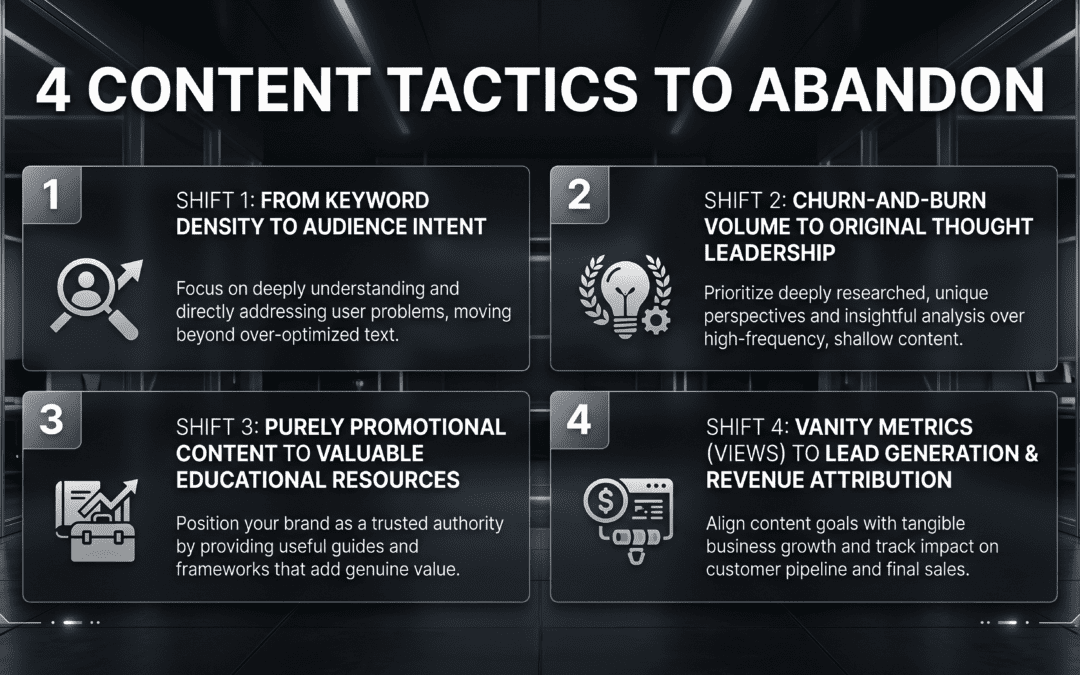
Maintain Search Visibility: 4 Content Tactics to Abandon
If you want to maintain search visibility across the United Kingdom commercial market today, the traditional playbook for organic online growth must be completely rewritten. For over a decade, the formula for digital visibility was predictable: identify a high-volume search term, insert it repeatedly into a 600-word article, secure a few basic backlinks, and watch your business rise on the results page.
In the current digital ecosystem, that exact approach will actively harm your brand. With the widespread rollout of generative AI overviews, vector-based semantic processing, and direct answer engines, the mechanics of online discovery have fundamentally transformed. Modern search systems no longer look for literal strings of matching text. Instead, they interpret underlying user intent, conceptual depth, and real-world expertise.
If your company relies on organic web traffic to generate high-value leads and acquire new clients, you must modernise your framework immediately. To maintain search visibility and protect your digital market share, you must abandon these four legacy content tactics without delay.
1. Eliminate Keyword Stacking to Maintain Search Visibility
The practice of building articles around a single, isolated search phrase—and forcing it into headings, introduction paragraphs, and meta tags—is completely obsolete. As detailed in recent platform updates documented by Search Engine Journal, modern search engines utilise advanced Natural Language Processing (NLP) models to map out entire concepts rather than tracking individual words. They evaluate “entities” (real-world people, places, organisations, and concepts) and analyse how comprehensively your content explains the relationships between them.
When you write solely to satisfy an arbitrary keyword frequency metric, your text becomes unnatural, narrow, and shallow. Search algorithms instantly recognize this lack of conceptual depth and will bypass your pages in favour of comprehensive resources.
What to Do Instead: Establish Topical Architecture
Shift your focus from tracking isolated words to building comprehensive topical clusters. If your business provides corporate professional services, do not simply write short, repetitive posts targeting a single city phrase. Instead, design an interconnected ecosystem of long-form articles that address infrastructure, data compliance regulations, and proactive risk mitigation. By mapping out the entire topical landscape, you signal to search engines that your website is an authoritative, trusted destination for that subject matter.
2. Cease Publishing Unedited Commodity AI Content
Generative AI platforms have made it incredibly simple to produce vast amounts of text in seconds. However, according to research on content saturation by the Content Marketing Institute, this ease of production has flooded the internet with an unprecedented volume of low-value, repetitive material. Search engines have updated their core helpful content systems to identify and demote what is now termed “commodity content”—surface-level text that merely duplicates existing web data without adding unique value.
Publishing unedited, generic AI-generated articles will lead to a rapid decline in your organic traffic. These automated summaries fail to demonstrate genuine first-hand experience, which is now a primary requirement if you want to maintain search visibility across competitive UK industries.
What to Do Instead: Introduce Proprietary Data and Case Studies
Every piece of content published on your corporate website must offer insights that an AI model cannot replicate with a basic text prompt. Integrate real-world case studies from your operations, unique customer data insights, direct commentary from your internal specialists, and practical troubleshooting examples. For instance, if you are discussing operational efficiency, share a specific, anonymised breakdown of how your team cleared a bottleneck for a client. This authentic, human-verified depth is exactly what search systems are looking to reward.
3. Reject Long, Unstructured Walls of Text
Many business owners still publish well-researched, high-quality insights but present them in long, unbroken paragraphs. While human readers find this formatting tiring, modern search engines find it highly inefficient. AI-driven answer engines rely heavily on fragment retrieval—the ability to scan a web page, extract a specific paragraph or list, and present it instantly as a direct answer to a user’s question.
If your content lacks a clear, machine-readable visual hierarchy, you are effectively masking your expertise from the automated systems that generate featured snippets and interactive search summaries.
What to Do Instead: Format Content for Instant Retrieval
To ensure your insights are easily extracted by modern search systems so you can maintain search visibility, structure your articles with absolute precision:
-
Use logical, clean Markdown headings (
##,###) to isolate distinct subtopics. -
Implement concise bullet points and numbered lists to present actionable steps clearly.
-
Place direct, one-sentence answers to common industry questions right beneath your subheadings.
-
Ensure your website framework utilizes relevant schema markup (such as Article or FAQ schema) to provide an explicit map of your data to search crawlers.
By organising your knowledge into clean, highly scannable segments, you maximize the chance of your brand being featured as the definitive source in automated search results.
4. Move Away from Broad, Low-Intent Informational Traffic
Historically, marketing success was measured by gross traffic volume. Companies routinely spent thousands of pounds producing content around massive, generic industry topics simply because those phrases attracted high monthly search volumes.
In the current search environment, chasing broad traffic is an inefficient use of your marketing budget. Because modern search engines answer simple, informational queries directly on the search results page using AI overviews, users rarely click through to external websites for basic definitions. If your content strategy is built entirely on answering simple “what is” questions, your click-through rates will inevitably drop.
What to Do Instead: Prioritise High-Intent, Commercial Conversion Content
Redirect your creative resources further down the commercial funnel. Focus heavily on crafting deep, high-intent assets that directly address the complex queries your prospects ask right before making a buying decision. Create comprehensive platform comparison guides, detailed cost breakdown analyses tailored to the UK market, technical implementation frameworks, and objective risk-mitigation resources.
To see how this fits into your wider corporate framework, view our comprehensive guide on modern service alignment and strategy optimization.
While these highly specific topics will naturally attract a smaller total volume of visitors, the traffic you do receive will consist of highly qualified leads who are actively ready to invest in your professional solutions.
Key Takeaways
-
Build Complete Clusters: Stop targeting isolated keywords; instead, construct robust topical architectures that prove your domain authority.
-
Inject Human Authority: Eliminate raw, unedited AI output. Ensure every page includes proprietary data, unique case studies, and distinct human expertise.
-
Optimise for Snippets: Divide your articles into clean, scannable, schema-ready fragments that automated answer engines can easily parse and display.
-
Target Commercial Value: Move away from broad, generic search volumes and invest heavily in bottom-of-the-funnel content to maintain search visibility where it counts.
Modernise Your Search Strategy
To maintain search visibility in an era dominated by AI answers and semantic search, your business must transition away from legacy, volume-driven tactics. Protecting your organic reach requires a deliberate commitment to topical depth, structural clarity, and authentic human insight.
If you want to audit your current digital footprint, expose hidden structural friction on your website, and realign your content architecture for modern semantic search engines, get in touch with our team today to arrange a comprehensive digital optimization review.