Maintain Search Visibility: 4 Content Tactics to Abandon
If you want to maintain search visibility across the United Kingdom commercial market today, the traditional playbook for organic online growth must be completely rewritten. For over a decade, the formula for digital visibility was predictable: identify a high-volume search term, insert it repeatedly into a 600-word article, secure a few basic backlinks, and watch your business rise on the results page.
In the current digital ecosystem, that exact approach will actively harm your brand. With the widespread rollout of generative AI overviews, vector-based semantic processing, and direct answer engines, the mechanics of online discovery have fundamentally transformed. Modern search systems no longer look for literal strings of matching text. Instead, they interpret underlying user intent, conceptual depth, and real-world expertise.
If your company relies on organic web traffic to generate high-value leads and acquire new clients, you must modernise your framework immediately. To maintain search visibility and protect your digital market share, you must abandon these four legacy content tactics without delay.
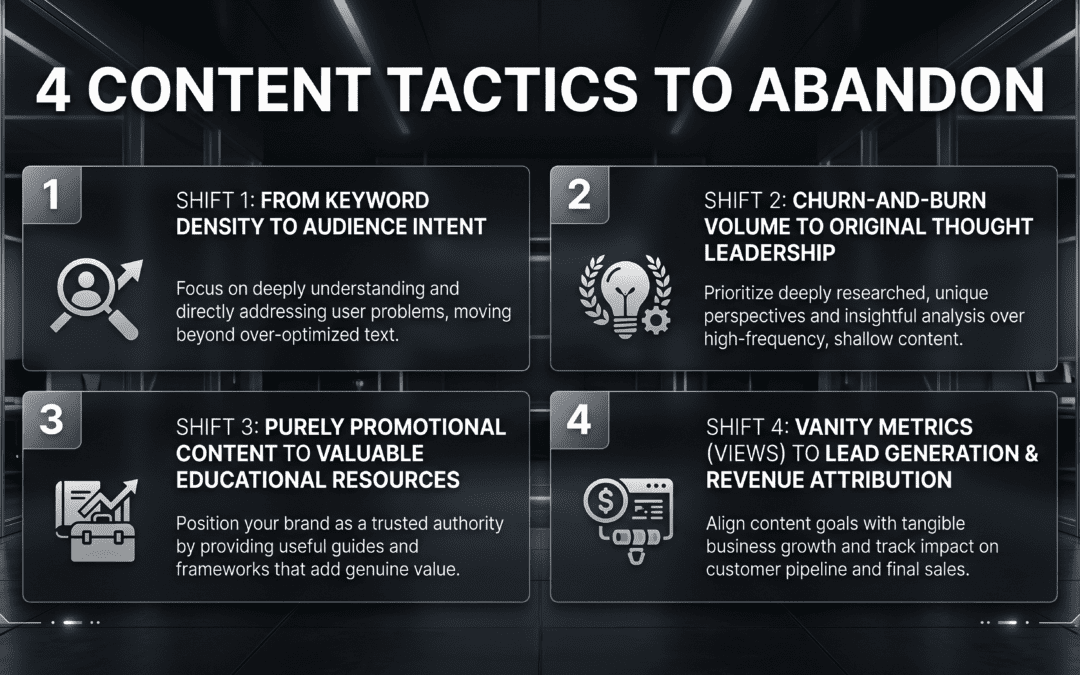
1. Eliminate Keyword Stacking to Maintain Search Visibility
The practice of building articles around a single, isolated search phrase—and forcing it into headings, introduction paragraphs, and meta tags—is completely obsolete. As detailed in recent platform updates documented by Search Engine Journal, modern search engines utilise advanced Natural Language Processing (NLP) models to map out entire concepts rather than tracking individual words. They evaluate “entities” (real-world people, places, organisations, and concepts) and analyse how comprehensively your content explains the relationships between them.
When you write solely to satisfy an arbitrary keyword frequency metric, your text becomes unnatural, narrow, and shallow. Search algorithms instantly recognize this lack of conceptual depth and will bypass your pages in favour of comprehensive resources.
What to Do Instead: Establish Topical Architecture
Shift your focus from tracking isolated words to building comprehensive topical clusters. If your business provides corporate professional services, do not simply write short, repetitive posts targeting a single city phrase. Instead, design an interconnected ecosystem of long-form articles that address infrastructure, data compliance regulations, and proactive risk mitigation. By mapping out the entire topical landscape, you signal to search engines that your website is an authoritative, trusted destination for that subject matter.
2. Cease Publishing Unedited Commodity AI Content
Generative AI platforms have made it incredibly simple to produce vast amounts of text in seconds. However, according to research on content saturation by the Content Marketing Institute, this ease of production has flooded the internet with an unprecedented volume of low-value, repetitive material. Search engines have updated their core helpful content systems to identify and demote what is now termed “commodity content”—surface-level text that merely duplicates existing web data without adding unique value.
Publishing unedited, generic AI-generated articles will lead to a rapid decline in your organic traffic. These automated summaries fail to demonstrate genuine first-hand experience, which is now a primary requirement if you want to maintain search visibility across competitive UK industries.
What to Do Instead: Introduce Proprietary Data and Case Studies
Every piece of content published on your corporate website must offer insights that an AI model cannot replicate with a basic text prompt. Integrate real-world case studies from your operations, unique customer data insights, direct commentary from your internal specialists, and practical troubleshooting examples. For instance, if you are discussing operational efficiency, share a specific, anonymised breakdown of how your team cleared a bottleneck for a client. This authentic, human-verified depth is exactly what search systems are looking to reward.
3. Reject Long, Unstructured Walls of Text
Many business owners still publish well-researched, high-quality insights but present them in long, unbroken paragraphs. While human readers find this formatting tiring, modern search engines find it highly inefficient. AI-driven answer engines rely heavily on fragment retrieval—the ability to scan a web page, extract a specific paragraph or list, and present it instantly as a direct answer to a user’s question.
If your content lacks a clear, machine-readable visual hierarchy, you are effectively masking your expertise from the automated systems that generate featured snippets and interactive search summaries.
What to Do Instead: Format Content for Instant Retrieval
To ensure your insights are easily extracted by modern search systems so you can maintain search visibility, structure your articles with absolute precision:
Use logical, clean Markdown headings (##, ###) to isolate distinct subtopics.
Implement concise bullet points and numbered lists to present actionable steps clearly.
Place direct, one-sentence answers to common industry questions right beneath your subheadings.
Ensure your website framework utilizes relevant schema markup (such as Article or FAQ schema) to provide an explicit map of your data to search crawlers.
By organising your knowledge into clean, highly scannable segments, you maximize the chance of your brand being featured as the definitive source in automated search results.
4. Move Away from Broad, Low-Intent Informational Traffic
Historically, marketing success was measured by gross traffic volume. Companies routinely spent thousands of pounds producing content around massive, generic industry topics simply because those phrases attracted high monthly search volumes.
In the current search environment, chasing broad traffic is an inefficient use of your marketing budget. Because modern search engines answer simple, informational queries directly on the search results page using AI overviews, users rarely click through to external websites for basic definitions. If your content strategy is built entirely on answering simple “what is” questions, your click-through rates will inevitably drop.
What to Do Instead: Prioritise High-Intent, Commercial Conversion Content
Redirect your creative resources further down the commercial funnel. Focus heavily on crafting deep, high-intent assets that directly address the complex queries your prospects ask right before making a buying decision. Create comprehensive platform comparison guides, detailed cost breakdown analyses tailored to the UK market, technical implementation frameworks, and objective risk-mitigation resources.
While these highly specific topics will naturally attract a smaller total volume of visitors, the traffic you do receive will consist of highly qualified leads who are actively ready to invest in your professional solutions.
Key Takeaways
Build Complete Clusters: Stop targeting isolated keywords; instead, construct robust topical architectures that prove your domain authority.
Inject Human Authority: Eliminate raw, unedited AI output. Ensure every page includes proprietary data, unique case studies, and distinct human expertise.
Optimise for Snippets: Divide your articles into clean, scannable, schema-ready fragments that automated answer engines can easily parse and display.
Target Commercial Value: Move away from broad, generic search volumes and invest heavily in bottom-of-the-funnel content to maintain search visibility where it counts.
Modernise Your Search Strategy
To maintain search visibility in an era dominated by AI answers and semantic search, your business must transition away from legacy, volume-driven tactics. Protecting your organic reach requires a deliberate commitment to topical depth, structural clarity, and authentic human insight.
If you want to audit your current digital footprint, expose hidden structural friction on your website, and realign your content architecture for modern semantic search engines, get in touch with our team today to arrange a comprehensive digital optimization review.
Google Search Essentials: What’s Changing for SEOs This Year
The days of simply stuffing keywords into a blog post and watching it rank on the first page are officially over. Google is evolving faster than ever, and for business owners in London and across the UK, keeping up is no longer optional—it is a matter of digital survival. Following the retirement of the traditional “Webmaster Guidelines” and the introduction of the modern Google Search Essentials, the algorithm has undergone a radical transformation. With artificial intelligence flooding the internet and user expectations at an all-time high, Google’s latest updates are designed to ruthlessly filter out digital noise. If your website traffic has suddenly dropped, or if you are struggling to break through the algorithmic ceiling, this guide will decode exactly what is changing this year and how you can position your brand for sustainable, long-term growth.
The Evolution of Google Search Essentials
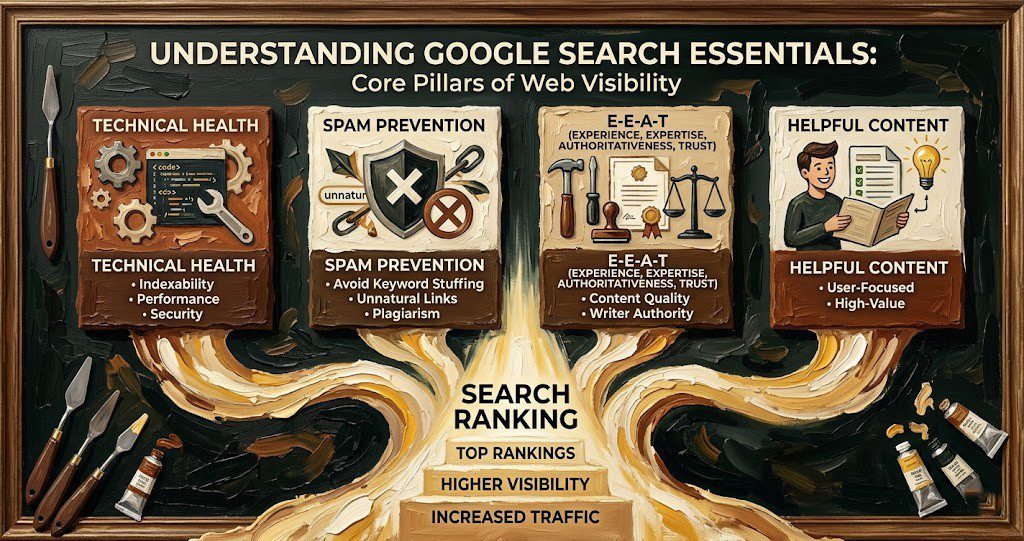
Understanding the shift in Google’s ecosystem begins with acknowledging that the search engine is no longer just looking for keywords; it is looking for genuine human value. The transition from Webmaster Guidelines to Google Search Essentials was not just a rebranding exercise. It was a fundamental shift in how Google expects websites to operate, focusing heavily on technical health, spam prevention, and the creation of helpful, people-first content.
From Checklists to Core Philosophies
Historically, SEO practitioners treated Google’s guidelines as a technical checklist. If you had the right meta tags, a fast server, and enough backlinks, you were almost guaranteed a top spot. Today, Google Search Essentials operate on core philosophies rather than rigid checklists. The algorithm uses machine learning to understand the intent behind a search query and evaluate whether a page genuinely satisfies that intent. This means that a perfectly optimised page with poor-quality information will be outranked by an unpolished page written by a true industry expert.
Why London Businesses Must Adapt
For a local business operating in a highly competitive market like London, this shift is critical. Local search is becoming hyper-personalised and intent-driven. If your competitors are providing deep, authoritative answers to customer questions while you are providing thin, generic copy, you will lose your digital footprint. Adapting to the new Search Essentials is the only way to safeguard your online visibility against unpredictable algorithm updates.
[INTERNAL LINK SUGGESTION: Link to a service page detailing your SEO Audit or Management Plans]
Navigating the New Spam Policies
Perhaps the most aggressive changes this year revolve around Google’s updated spam policies. As AI tools make it easier than ever to mass-produce content, Google has deployed sophisticated countermeasures to protect its search results from manipulation. Ignorance of these policies can result in a manual action, effectively wiping your website from the search index.
The Crackdown on Scaled Content Abuse
Scaled content abuse occurs when a website publishes massive volumes of unoriginal or low-value content primarily to manipulate search rankings. In the past, this was done via article spinning or scraped content. Today, it is largely driven by poorly supervised generative AI. Google’s algorithms are now highly adept at detecting repetitive, unhelpful content generated at scale. If your strategy involves publishing dozens of generic AI-written articles a week without human editing, expert insight, or original thought, you are in the algorithmic danger zone. 🌟
Targeting Site Reputation Abuse
Often referred to in the industry as “parasite SEO,” site reputation abuse happens when third-party pages are published with little or no first-party oversight or involvement, solely to piggyback on the host site’s ranking signals. For example, if a reputable educational website suddenly hosts a page about “the best payday loans,” Google will now penalise both the third party and the host. Business owners must rigorously audit any sponsored content or third-party partnerships on their domains.
Ending Expired Domain Abuse
A popular tactic among black-hat SEOs was to purchase expired domains that already had high authority and repurpose them to host low-quality affiliate content. Google’s new policies explicitly classify this as spam. The search engine’s historical data tracking ensures that if a domain changes hands and its core topic shifts drastically to low-value content, its previous authority is instantly nullified.
The Integration of the Helpful Content System
The Helpful Content update began as a standalone filter, but this year, it has been fully integrated into Google’s core ranking system. This means that “helpfulness” is no longer an occasional algorithmic check; it is a continuous, real-time ranking factor that impacts your entire website.
People-First vs. Search-Engine-First
Google assesses whether content was created primarily to rank on search engines or to help people. Search-engine-first content usually summarises what others have already said without adding any original value, heavily relies on automation, and leaves the reader feeling like they need to search again to get a real answer. People-first content, on the other hand, demonstrates first-hand experience, provides unique insights, and completely satisfies the user’s query. If you are a solo expert, your content must reflect your personal expertise and unique viewpoint. 💡
The Danger of the “Sitewide Signal”
The helpful content system acts as a sitewide signal. This means that if Google determines a significant portion of your website consists of unhelpful, low-quality content, it can suppress the rankings of your entire domain—even the high-quality pages. It is highly recommended to conduct a brutal content audit. Delete or rewrite old, thin, or irrelevant blog posts. In 2026, less content of higher quality will always outperform vast amounts of mediocre content.
E-E-A-T and the AI Content Conundrum
As generative AI changes how we write, Google leans heavily on E-E-A-T (Experience, Expertise, Authoritativeness, and Trustworthiness) to differentiate human experts from bots. AI can simulate knowledge, but it cannot simulate real-world experience.
Google’s Stance on AI Content
Google has clarified that it is not against AI content itself. The policy focuses on the quality of the content, regardless of how it is produced. If you use AI to draft an article, but you review it, inject your personal business experience, add original case studies, and ensure factual accuracy, Google will reward it. However, unedited, copy-pasted AI outputs will fail the E-E-A-T test immediately.
Demonstrating the “E” for Experience
The most recent addition to the E-E-A-T acronym is “Experience.” Google wants to see proof that the author has actually experienced what they are writing about. If you are reviewing a software tool, include original screenshots. If you are writing about a marketing strategy, include real data from your own campaigns. Using phrases like “In my experience working with London businesses…” followed by genuine insights is a powerful way to signal human authenticity to the algorithm.
Core Web Vitals: The Reign of INP
Technical SEO remains a non-negotiable pillar of the Google Search Essentials. While content quality is paramount, Google will not send users to a website that is slow, frustrating, or broken. This year, the metrics for measuring user experience have shifted.
Interaction to Next Paint (INP)
Google has officially replaced First Input Delay (FID) with Interaction to Next Paint (INP) as a Core Web Vital. While FID only measured the delay of the very first interaction a user had with a page, INP measures the latency of all interactions throughout the entire time a user is on the page. If a user clicks a button, opens an accordion menu, or adds an item to a cart, and the site hesitates or lags, your INP score will plummet. A poor INP score acts as a drag on your overall search rankings.
Mobile-First is the Only Indexing
Google has completed its transition to mobile-first indexing. The desktop version of your site is now entirely irrelevant to Google’s crawlers. If your website is not perfectly responsive, fast, and easy to navigate on a smartphone, you will struggle to rank. Ensure that your mobile text size is readable, buttons are spaced adequately for touch, and heavy scripts are deferred to improve loading times. 📱
Building a Future-Proof SEO Strategy
Adapting to these changes requires a shift in mindset. You must stop optimising for the algorithm and start optimising for the user, trusting that Google’s algorithm is now smart enough to recognise the difference.
Focus on Topic Clusters
Instead of writing isolated blog posts targeting single keywords, build topic clusters. Create a comprehensive “pillar” page that covers a broad topic, and then write several detailed “cluster” articles that explore specific subtopics in depth. Link all the cluster articles back to the pillar page. This structure signals to Google that you possess deep, comprehensive topical authority, making you a trusted source in your niche.
Cultivate Your Digital Footprint
Your reputation off-site matters just as much as your on-site content. Engage in digital PR, get featured in industry publications, and build a strong social media presence. When users search for your brand name alongside your services, it sends a powerful trust signal to Google. Building a personal brand as an expert is one of the most effective ways to secure your search rankings against future algorithm volatility.
Key Takeaways for This Year
Ready to Dominate the Search Results?
Navigating Google’s rapid algorithm changes can be overwhelming when you are trying to run a business. You do not have to do it alone. As a solo expert specialising in the London market, I provide bespoke SEO and digital strategy Management Plans tailored to protect your brand and drive sustainable, high-converting organic traffic. Stop guessing what Google wants and start leading your industry. Contact me today to secure your Management Plan and let’s turn your website into your most powerful asset.
In the quiet, high-ceilinged offices of Marylebone and the glass towers of the City, a silent revolution has finalised its coup. The digital landscape has relegated the traditional search engine to a secondary tool. Today, optimising for AI assistants 2026 represents the primary objective for the London elite. Consequently, people no longer “Google it”; they simply ask their devices for a singular, trusted recommendation. If AI assistants do not recommend your brand immediately, you effectively do not exist in the modern ecosystem.
The Shift from Rankings to Recommendations
Traditional SEO focused heavily on volume and keyword density. However, optimising for AI assistants 2026 requires a sophisticated focus on trust and entity clarity. In the current market, AI engines do not merely look for “relevant content.” Instead, they seek out “verified authority.” These systems synthesise thousands of data points—from your website’s schema to your mentions in authoritative sources—to decide if you deserve a recommendation.
If the AI cannot parse your data instantly, the algorithm will skip your content entirely. Therefore, implementing advanced Schema Markup is no longer optional; it is the fundamental language of discovery. Your site must clearly define your “Entity.” Specifically, you must outline who you are, what you offer, and which problems your Management Plans solve for the London market.
2. Solving for ‘Natural Language’ Intent
AI assistants thrive on conversational context. As a result, your content strategy must shift away from broad terms like “London Real Estate.” Furthermore, you must answer the nuanced, high-intent questions of your audience. Consider the verbal prompts a busy executive gives their AI while stuck in traffic on the A4: “Find me a management plan that specialises in high-yield sustainable assets in East London.”
By focusing on optimising for AI assistants 2026, your whitepapers must provide these answers with surgical precision. This approach mirrors the high standards found at the Content Marketing Institute.
3. The Trust Signal: Third-Party Verification
Modern AI acts with inherent skepticism because it cross-references every claim you make. To secure a recommendation, you must build a “cluster of authority.” This process involves three key pillars:
Citations: Secure mentions in reputable UK publications to build digital footprints.
Sentiment: Manage your reviews so they reflect the “Quiet Luxury” London demands.
Consistency: Maintain identical, verified information across all London Digital Pulse updates.
The Conclusion for the 2026 Strategist
The era of the “Ten Blue Links” has officially ended. In contrast, we have entered the era of the Singular Answer. By pivoting your strategy to focus on AI legibility and conversational authority, you ensure that your brand remains the top choice. Ultimately, you must master the assistant or risk being forgotten by the market.
The digital landscape of the United Kingdom has reached a tipping point. As we analyze the latest market data, it is clear that 2026 social search habits have fundamentally transformed how London’s consumers—particularly Gen Z and Millennials—find products, services, and expertise. Recent reports from the Global Intelligence Scan reveal a staggering 86% shift in these patterns.
Why Discovery Patterns are Fragmenting the Market
In the current era, “searching” is no longer a singular action performed on a white screen. Understanding these modern 2026 discovery patterns requires looking at a fragmented, multi-platform journey. While Google remains a powerhouse for high-consequence decisions, the preference for TikTok and AI-driven “Answer Engines” has evolved into a sophisticated discovery layer.
TikTok: The primary hub for lifestyle and real-time intent.
Instagram: A visual directory where AI now indexes objects inside your Reels.
AI Assistants: Now accounting for 14% of direct search intent in London.
The “Discovery Loop” and Modern Intent
The traditional marketing funnel is dead. In its place is the Discovery Loop, a cycle driven by evolving user behaviors. A user might see a concept on a Pinterest “Identity Board,” search for the practical application on TikTok, and finally verify a brand’s “Topical Authority” on LinkedIn. To capture this audience, your Management Plans must be platform-native but search-optimised.
According to research by HubSpot, over half of consumers now start their journey on social media rather than a search engine. This means your brand needs to be “machine-readable” across all surfaces.
Strategic Pivot: Dominating the New Landscape
To align your brand with these shifting UK search trends, focus on three pillars:
Visual SEO: Use descriptive Alt-Text that AI nodes can index instantly.
AI-Ready Answers: Provide concise answers that “Answer Engines” can cite in their snapshots.
Human-Centric Branding: Focus on trust and verifiable credentials to stand out from AI-generated noise.
By diversifying your presence, you ensure that your business remains visible wherever the search bar appears next.