Google Search Essentials: What’s Changing for SEOs This Year
Google Search Essentials: What’s Changing for SEOs This Year
The days of simply stuffing keywords into a blog post and watching it rank on the first page are officially over. Google is evolving faster than ever, and for business owners in London and across the UK, keeping up is no longer optional—it is a matter of digital survival. Following the retirement of the traditional “Webmaster Guidelines” and the introduction of the modern Google Search Essentials, the algorithm has undergone a radical transformation. With artificial intelligence flooding the internet and user expectations at an all-time high, Google’s latest updates are designed to ruthlessly filter out digital noise. If your website traffic has suddenly dropped, or if you are struggling to break through the algorithmic ceiling, this guide will decode exactly what is changing this year and how you can position your brand for sustainable, long-term growth.
The Evolution of Google Search Essentials
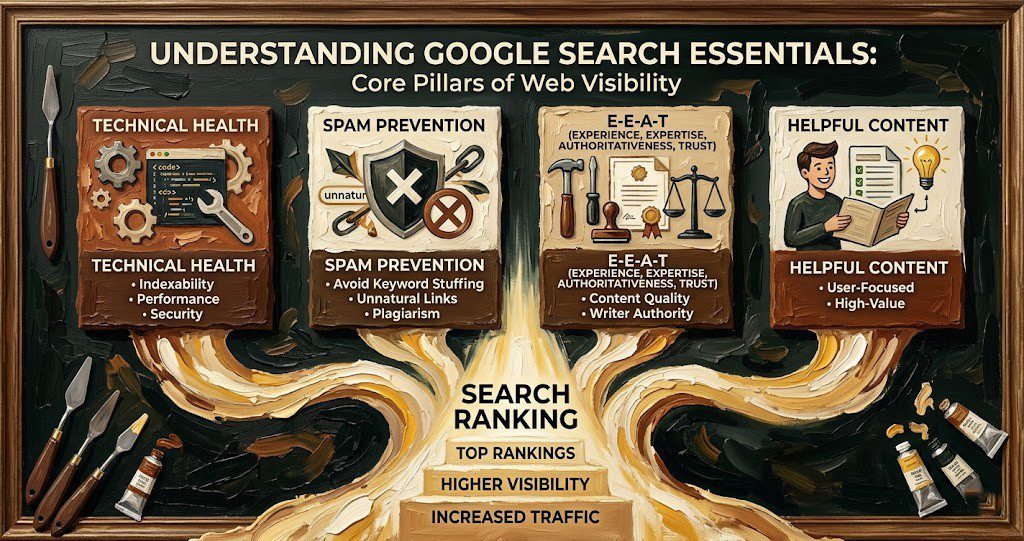
Understanding the shift in Google’s ecosystem begins with acknowledging that the search engine is no longer just looking for keywords; it is looking for genuine human value. The transition from Webmaster Guidelines to Google Search Essentials was not just a rebranding exercise. It was a fundamental shift in how Google expects websites to operate, focusing heavily on technical health, spam prevention, and the creation of helpful, people-first content.
From Checklists to Core Philosophies
Historically, SEO practitioners treated Google’s guidelines as a technical checklist. If you had the right meta tags, a fast server, and enough backlinks, you were almost guaranteed a top spot. Today, Google Search Essentials operate on core philosophies rather than rigid checklists. The algorithm uses machine learning to understand the intent behind a search query and evaluate whether a page genuinely satisfies that intent. This means that a perfectly optimised page with poor-quality information will be outranked by an unpolished page written by a true industry expert.
Why London Businesses Must Adapt
For a local business operating in a highly competitive market like London, this shift is critical. Local search is becoming hyper-personalised and intent-driven. If your competitors are providing deep, authoritative answers to customer questions while you are providing thin, generic copy, you will lose your digital footprint. Adapting to the new Search Essentials is the only way to safeguard your online visibility against unpredictable algorithm updates.
[INTERNAL LINK SUGGESTION: Link to a service page detailing your SEO Audit or Management Plans]
Navigating the New Spam Policies
Perhaps the most aggressive changes this year revolve around Google’s updated spam policies. As AI tools make it easier than ever to mass-produce content, Google has deployed sophisticated countermeasures to protect its search results from manipulation. Ignorance of these policies can result in a manual action, effectively wiping your website from the search index.
The Crackdown on Scaled Content Abuse
Scaled content abuse occurs when a website publishes massive volumes of unoriginal or low-value content primarily to manipulate search rankings. In the past, this was done via article spinning or scraped content. Today, it is largely driven by poorly supervised generative AI. Google’s algorithms are now highly adept at detecting repetitive, unhelpful content generated at scale. If your strategy involves publishing dozens of generic AI-written articles a week without human editing, expert insight, or original thought, you are in the algorithmic danger zone. 🌟
Targeting Site Reputation Abuse
Often referred to in the industry as “parasite SEO,” site reputation abuse happens when third-party pages are published with little or no first-party oversight or involvement, solely to piggyback on the host site’s ranking signals. For example, if a reputable educational website suddenly hosts a page about “the best payday loans,” Google will now penalise both the third party and the host. Business owners must rigorously audit any sponsored content or third-party partnerships on their domains.
Ending Expired Domain Abuse
A popular tactic among black-hat SEOs was to purchase expired domains that already had high authority and repurpose them to host low-quality affiliate content. Google’s new policies explicitly classify this as spam. The search engine’s historical data tracking ensures that if a domain changes hands and its core topic shifts drastically to low-value content, its previous authority is instantly nullified.
The Integration of the Helpful Content System
The Helpful Content update began as a standalone filter, but this year, it has been fully integrated into Google’s core ranking system. This means that “helpfulness” is no longer an occasional algorithmic check; it is a continuous, real-time ranking factor that impacts your entire website.
People-First vs. Search-Engine-First
Google assesses whether content was created primarily to rank on search engines or to help people. Search-engine-first content usually summarises what others have already said without adding any original value, heavily relies on automation, and leaves the reader feeling like they need to search again to get a real answer. People-first content, on the other hand, demonstrates first-hand experience, provides unique insights, and completely satisfies the user’s query. If you are a solo expert, your content must reflect your personal expertise and unique viewpoint. 💡
The Danger of the “Sitewide Signal”
The helpful content system acts as a sitewide signal. This means that if Google determines a significant portion of your website consists of unhelpful, low-quality content, it can suppress the rankings of your entire domain—even the high-quality pages. It is highly recommended to conduct a brutal content audit. Delete or rewrite old, thin, or irrelevant blog posts. In 2026, less content of higher quality will always outperform vast amounts of mediocre content.
E-E-A-T and the AI Content Conundrum
As generative AI changes how we write, Google leans heavily on E-E-A-T (Experience, Expertise, Authoritativeness, and Trustworthiness) to differentiate human experts from bots. AI can simulate knowledge, but it cannot simulate real-world experience.
Google’s Stance on AI Content
Google has clarified that it is not against AI content itself. The policy focuses on the quality of the content, regardless of how it is produced. If you use AI to draft an article, but you review it, inject your personal business experience, add original case studies, and ensure factual accuracy, Google will reward it. However, unedited, copy-pasted AI outputs will fail the E-E-A-T test immediately.
Demonstrating the “E” for Experience
The most recent addition to the E-E-A-T acronym is “Experience.” Google wants to see proof that the author has actually experienced what they are writing about. If you are reviewing a software tool, include original screenshots. If you are writing about a marketing strategy, include real data from your own campaigns. Using phrases like “In my experience working with London businesses…” followed by genuine insights is a powerful way to signal human authenticity to the algorithm.
Core Web Vitals: The Reign of INP
Technical SEO remains a non-negotiable pillar of the Google Search Essentials. While content quality is paramount, Google will not send users to a website that is slow, frustrating, or broken. This year, the metrics for measuring user experience have shifted.
Interaction to Next Paint (INP)
Google has officially replaced First Input Delay (FID) with Interaction to Next Paint (INP) as a Core Web Vital. While FID only measured the delay of the very first interaction a user had with a page, INP measures the latency of all interactions throughout the entire time a user is on the page. If a user clicks a button, opens an accordion menu, or adds an item to a cart, and the site hesitates or lags, your INP score will plummet. A poor INP score acts as a drag on your overall search rankings.
Mobile-First is the Only Indexing
Google has completed its transition to mobile-first indexing. The desktop version of your site is now entirely irrelevant to Google’s crawlers. If your website is not perfectly responsive, fast, and easy to navigate on a smartphone, you will struggle to rank. Ensure that your mobile text size is readable, buttons are spaced adequately for touch, and heavy scripts are deferred to improve loading times. 📱
Building a Future-Proof SEO Strategy
Adapting to these changes requires a shift in mindset. You must stop optimising for the algorithm and start optimising for the user, trusting that Google’s algorithm is now smart enough to recognise the difference.
Focus on Topic Clusters
Instead of writing isolated blog posts targeting single keywords, build topic clusters. Create a comprehensive “pillar” page that covers a broad topic, and then write several detailed “cluster” articles that explore specific subtopics in depth. Link all the cluster articles back to the pillar page. This structure signals to Google that you possess deep, comprehensive topical authority, making you a trusted source in your niche.
Cultivate Your Digital Footprint
Your reputation off-site matters just as much as your on-site content. Engage in digital PR, get featured in industry publications, and build a strong social media presence. When users search for your brand name alongside your services, it sends a powerful trust signal to Google. Building a personal brand as an expert is one of the most effective ways to secure your search rankings against future algorithm volatility.
Key Takeaways for This Year
Ready to Dominate the Search Results?
Navigating Google’s rapid algorithm changes can be overwhelming when you are trying to run a business. You do not have to do it alone. As a solo expert specialising in the London market, I provide bespoke SEO and digital strategy Management Plans tailored to protect your brand and drive sustainable, high-converting organic traffic. Stop guessing what Google wants and start leading your industry. Contact me today to secure your Management Plan and let’s turn your website into your most powerful asset.
#GoogleSearchEssentials #SEOUpdates #HelpfulContent #EEAT #TechnicalSEO